


Introduction
When your baby is ready for solids, the goal is to build a baby diet that starts introducing a range of textures and tastes gradually. Baby’s usual milk should still be their main source of nutrition during the first year. Introducing solids usually starts at around 6 months, once your baby has shown clear signs of being ready. Following your baby’s cues you can move from smooth spoon-fed foods to thicker textures and then finger foods.
Starting weaning can feel exciting, messy and a little overwhelming all at once. That’s completely normal. What matters most is taking it step by step, keeping things relaxed and letting your little one learn and progress at their own pace.
When should my baby start solid foods?
The HSE recommends starting solids at around 6 months1, and not earlier than 17 weeks. That’s because babies need time to develop the skills needed to chew and digest food safely.
Some signs that can tell you your little one might be getting ready for solid foods:
- They stay sitting up while holding their head steady
- They reach for food and bring it to their mouth, coordinating their eyes with their hands and mouth
- They swallow food rather than pushing it straight back out with their toungue
It’s easy to wonder whether other baby behaviours mean they’re ready too. Things like chewing their fists, waking more in the night or seeming extra keen for milk. But while those moments can feel very ‘weaning-like’, they are usually just part of normal baby development rather than a clear sign that solids should start.
How do milk and solids balance from 6 to 12 months?
At the beginning of the weaning journey, solids are really about helping your baby learn. It is not replacing milk. Your baby will still get most of their energy and nutrients from their usual milk.
A simple way to think about the stages of weaning and how best to approach them is:
- Around 6 months: offer a small amount of solids once a day while continuing your usual milk feeds
- Around 7 to 9 months: gradually build towards more meals and more texture variety
- Around 10 to 12 months: your baby may be eating more family foods, but their milk still plays an important role
For more information about how to start your weaning journey check out SMA’s guide on Stage 1 Weaning.
When to stop using follow-on formula milk?
There is no need to rush the transition. In the first stages of weaning the focus should be on how to gently bring solids into your baby’s diet, alongside follow-on formula milk. This period is about helping your little one explore simple tastes and textures, especially iron-rich foods and vegetables.
Follow-on milks are specially designed to complement the weaning diet. SMA’s Follow-on Milk, for example, is fortified with iron, vitamin D, calcium and Omega 3 and 6 ensuring your little one gets the nutritients they need while they explore solid foods.
Introducing solids is an important time for your baby’s development, especially in establishing their gut microbiome. Balancing this transition, and going at a pace that works best for baby is all part of developing a foundation for good gut health – learn more about supporting gut health during weaning.
What foods should I start weaning my baby with?
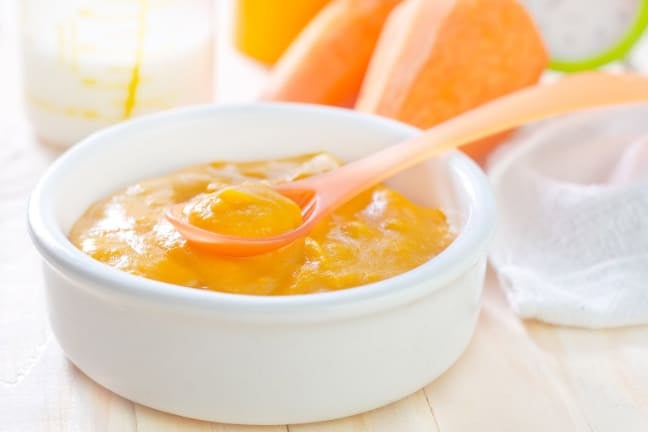
When you begin weaning, it helps to think of food as a learning journey rather than a test your baby has to pass. In those early weeks, the aim is simply to introduce your baby to new tastes, new textures and the idea that food can be exciting as well as nourishing.
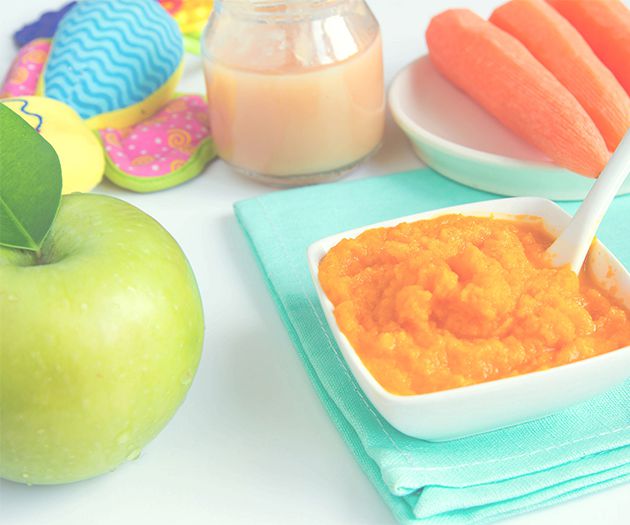
A simple place to begin is with a purée of a single vegetables such as carrot, sweet potato or broccoli. From there, you can gradually move from smooth purées to thicker mash, then soft lumps, and then to soft finger foods your baby can hold themselves. That steady progression helps your baby get used to food one step at a time, without making mealtimes feel too big or overwhelming.
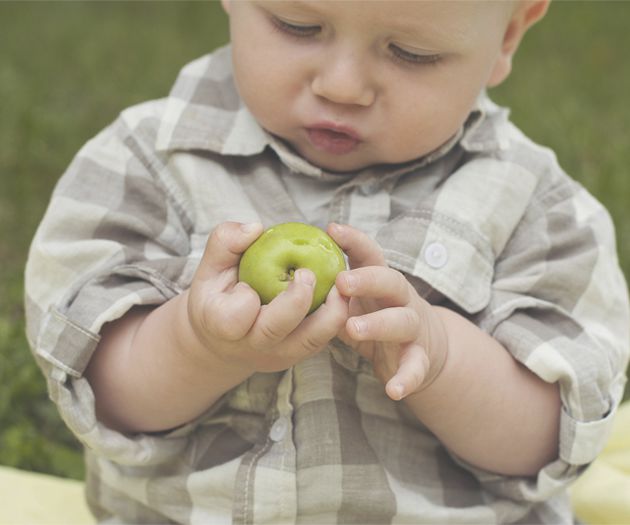
This approach works well whether you’re following baby-led weaning, spoon-feeding, or a mixture of both. Some babies are happy to explore food with their hands right away, which is a form of infant led feeding. Others prefer a bit of help at first, with spoon-feeding alongside opportunities to pick up and explore food for themselves.
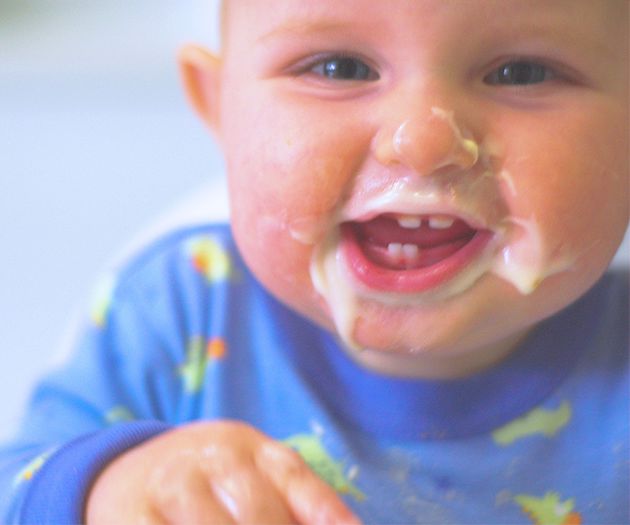
If your baby loves squashing food between their fingers before eating much of it, that’s still progress. It means they’re learning about smell, texture, shape and taste – which form the building blocks of a positive baby food journey.
How to reduce choking risk during weaning?
It’s very common for babies to gag while they’re learning to eat. While it can look and sound unsettling, it is usually just part of getting used to different textures and learning how to move food around their mouth. As your baby becomes more confident with eating, this often settles with time. Knowing the difference between gagging (a loud noise, with redness in the cheeks) and choking (often a quieter sound and skin, gums or fingernails may turn blue)2 can help you feel a little calmer at mealtimes.
A few simple habits can help make things feel safer and more manageable:
- Always sit your baby upright while they eat
- Stay with them throughout meals
- Cut round foods like grapes lengthways and then into small pieces
- Soften harder foods well by cooking them thoroughly
- Remove pips, stones and bones before serving
- Do not give whole nuts
- when offering finger foods, choose soft, easy-to-hold shapes the size of your own finger to that your baby can grasp safely3
These small steps can make a big difference while your baby is still learning.
What to do if an infant chokes?
If you think your baby is choking and cannot breathe properly, the HSE recommends the following steps are taken2:
Step 1 - slap it out
Sit down. Hold your baby's face down on your forearm while resting your forearm on your knee. Make sure to support their head, jaw and neck. Their head should be lower than their body.
Give 5 back slaps using the heel of your other hand between your baby’s shoulders.
Step 2 - squeeze it out
Turn your baby over so they are lying face up along your forearm while resting on your thigh. Make sure you support their head and neck.
Find their breast bone. This is in the centre of their chest, in line with their armpits.
Place 2 fingers in the middle of their chest and push sharply on the chest. Give 5 of these chest thrusts.
Step 3 - call 112 or 999
Keep doing 5 back slaps and 5 chest thrusts. Do this until the object pops out, the ambulance arrives or your baby becomes unresponsive.
Finding the right balance: milk and solids
Finding the right balance between your baby’s usual milk and solids takes a little time, and it doesn’t need to happen all at once. In the early months of weaning, follow-on milk still does most of the nutritional heavy lifting, while solids help your baby explore new tastes, textures and routines at their own pace. Keeping that balance gradual can make weaning feel calmer, safer and more enjoyable for both of you.
If some days your baby is more interested in milk and other days more curious about food, that’s completely normal. What matters most is continuing their usual milk feeds, offering nourishing first foods, and letting their confidence build step by step. Over time, those small tastes and mealtime moments begin to come together naturally.
IMPORTANT NOTICE: We believe that breastfeeding is the ideal nutritional start for babies and we fully support the World Health Organization’s recommendation of exclusive breastfeeding for the first six months of life followed by the introduction of adequate nutritious complementary foods along with continued breastfeeding up to two years of age. We also recognise that breastfeeding is not always an option for parents. We recommend that you speak to your healthcare professional about how to feed your baby and seek advice on when to introduce complementary feeding.
If you choose not to breastfeed, please remember that such a decision can be difficult to reverse and has social and financial implications. Introducing partial bottle-feeding will reduce the supply of breast milk. Follow-on Milk is only suitable for babies over 6 months as part of a mixed diet. It should not be used as a substitute for breast milk during the first 6 months. The decision to start weaning or to use this product before 6 months, should be made only on the advice of a doctor, midwife, health visitor, public health nurse, dietitian or pharmacist, based on baby’s individual needs.

Author
Ellie Grove
Registered Dietitian, SMA® Nutrition UK&I
Ellie is a registered Dietitian and has a First Class BSc (Hons) degree in Nutrition and Dietetics from Surrey University.
She’s one of our lead health writers in the medical affairs team and specialises in baby feeding issues and specialist products.
She has a keen eye for rigorous research and enjoys dissecting health-related science and making it accessible and applicable to everyone.
Share on